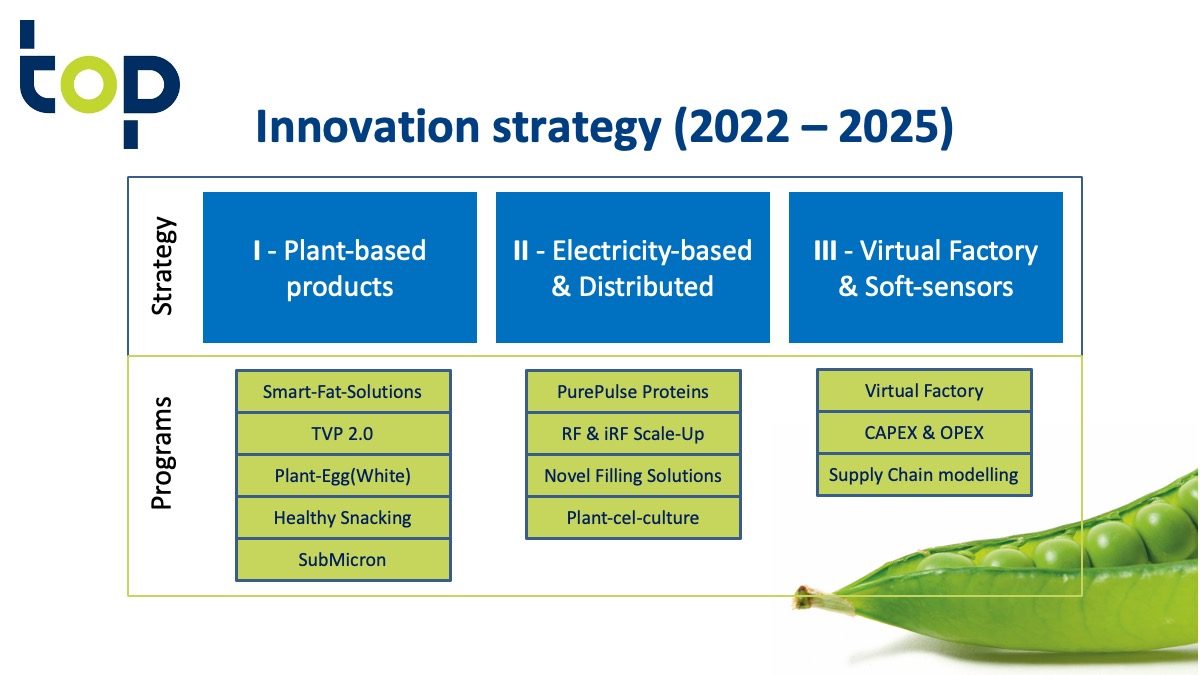
Introduction:
In an era of increasing environmental consciousness, the electrification of food factories stands as a transformative strategy for reducing carbon emissions and creating sustainable food production systems. TOP b.v. (Wageningen), an innovation and R&D organization dedicated to revolutionizing the food industry, recognizes the urgent need to transition away from fossil fuel dependence. Our vision entails going ‘all electric’ by eliminating the use of natural gas and embracing a range of novel technologies. This article highlights the importance of phasing out natural gas, explores mild preservation technologies like High-Pressure Processing (HPP) and Pulsed Electric Fields (PEF), delves into advanced heating methods utilizing radio waves, and underscores the introduction of high-power industrial heat pumps. Furthermore, we envision the factories of the future as sensor-networked and net-zero entities.
Phasing out Natural Gas: Going ‘All Electric’:
To achieve a sustainable future, it is imperative to transition away from natural gas, a fossil fuel that contributes to greenhouse gas emissions. TOP b.v. (Wageningen) recognizes the urgency of reducing carbon footprints and advocates for the complete elimination of natural gas as a basic energy source in food factories. By going ‘all electric,’ we aim to rely solely on electricity generated from renewable sources, such as solar and wind power.
The benefits of this transition extend beyond environmental impact. Electric-powered factories offer enhanced operational efficiency, improved control over energy consumption, and reduced maintenance requirements compared to their fossil fuel-powered counterparts. By embracing all-electric systems, TOP b.v. (Wageningen) strives to create a resilient and sustainable food production ecosystem.
Mild Preservation Technologies: HPP and Pulsed Electric Fields (PEF):
In the pursuit of sustainable food production, TOP b.v. (Wageningen) places significant emphasis on the implementation of mild preservation technologies. High-Pressure Processing (HPP) and Pulsed Electric Fields (PEF) are innovative techniques that extend the shelf life of food products without the need for chemical additives or high-temperature treatments.
HPP involves subjecting food to high hydrostatic pressure, effectively eliminating harmful microorganisms while preserving the nutritional integrity and sensory attributes of the product. PEF, on the other hand, applies short bursts of high-voltage electrical pulses to inactivate microorganisms and enzymes. Both methods offer a viable alternative to traditional thermal preservation techniques, ensuring food safety while retaining the quality and freshness of the products.
Advanced Heating Methods: Radiowave Heating:
TOP b.v. (Wageningen) embraces advanced heating methods that utilize radio waves as an energy source. Radio-wave heating is a promising technology that offers precise and efficient heat transfer in food processing. Unlike conventional heating methods, radio-wave heating allows for targeted and uniform heat distribution, reducing processing time and energy consumption.
By adopting radio-wave heating, TOP b.v. (Wageningen) aims to optimize the production processes in food factories. This technology enables rapid and controlled heating, leading to improved product quality, reduced nutrient loss, and enhanced energy efficiency. Additionally, radio-wave heating offers the advantage of precise temperature control, minimizing the risk of over-processing and ensuring the preservation of sensory attributes.
Introduction of High-Power Industrial Heat Pumps:
As part of our electrification strategy, TOP b.v. (Wageningen) focuses on the introduction of high-power industrial heat pumps. Heat pumps utilize electrical energy to transfer heat from one location to another, offering an energy-efficient alternative to traditional heating systems. By leveraging this technology, we aim to optimize the heating and cooling processes in food factories.
High-power industrial heat pumps enable the utilization of waste heat, allowing for effective heat recovery and reuse. This reduces the overall energy consumption and carbon emissions associated with food processing. Moreover, heat pumps can be integrated with renewable energy sources, such as geothermal or solar thermal systems, further enhancing the sustainability of food factories.
Sensor-Networked Factories: Towards Net-Zero Operations:
The factories of the future envisioned by TOP b.v. (Wageningen) are sensor-networked, interconnected systems that optimize energy consumption, production efficiency, and resource management. By integrating smart sensors and advanced data analytics, these factories can monitor and control various parameters in real-time, ensuring optimal performance while minimizing waste.
Through comprehensive data collection and analysis, sensor-networked factories enable precise energy management, predictive maintenance, and streamlined production processes. Furthermore, these factories strive to achieve net-zero operations by implementing renewable energy generation, energy storage systems, and advanced energy management strategies. The ultimate goal is to create self-sustaining and environmentally responsible food production facilities.
Conclusion:
TOP b.v. (Wageningen) is committed to leading the charge in the electrification of food factories, envisioning a future that is sustainable, efficient, and environmentally conscious. By phasing out natural gas, adopting mild preservation technologies like HPP and PEF, embracing advanced heating methods utilizing radio waves, introducing high-power industrial heat pumps, and implementing sensor-networked systems, we aim to revolutionize the food industry.
Through our efforts, we strive to create food factories that are powered by renewable energy, minimize carbon emissions, optimize resource utilization, and operate at peak efficiency. By pushing the boundaries of innovation and collaboration, TOP b.v. (Wageningen) paves the way for a greener and more sustainable future, ensuring a positive impact on the environment and the communities we serve.
 Food4Innovations (EN) - Wouter de Heij M.Sc.
One thought on “PART 5 – Pioneering the Future: Electrification of Food Factories with the Purpose to go Net-Zero and improve Food Quality. Detailed insight’s of TOP’s Strategy 2022-2025.”