
Introduction.
In the realm of economics, the structure of markets plays a vital role in shaping competition, pricing strategies, and overall market dynamics. Two significant market structures that have garnered considerable attention are oligopoly and oligopsony. These market types have distinct characteristics that affect the behavior of firms and the welfare of producers and consumers. This article aims to provide an in-depth understanding of oligopoly and oligopsony (see Article I – The Farm Problem), their implications for market participants, and the challenges they pose. Part of this article is a summary of other market dynamics in the field of economics too.
Additionally, we will explore the concept of price elasticity and its relevance in these market structures. By examining these topics, we can gain valuable insights into the Farm Problem and the broader landscape of market economics.
I. Understanding Oligopoly – more clients then suppliers.
Before delving into the intricacies of oligopsony and its impact on the agricultural sector, it is crucial to grasp the fundamentals of oligopoly. Oligopoly refers to a market structure in which a limited number of firms dominate a significant portion of the market. These firms have the ability to influence prices, output levels, and overall market competition. Due to their market power, oligopolistic firms often engage in strategic decision-making, taking into account the actions and reactions of their competitors.
In an oligopoly, firms may employ various strategies to gain a competitive edge, such as price leadership, product differentiation, or collusion. Price leadership occurs when one firm takes the lead in setting prices, and other firms follow suit. This strategy aims to minimize price wars and maintain a stable market environment. Product differentiation, on the other hand, involves creating unique features or branding to distinguish products and attract customers. Collusion, although illegal in many jurisdictions, involves firms conspiring to restrict competition, leading to higher prices and reduced consumer welfare.

II. Exploring Oligopsony – more suppliers then clients.
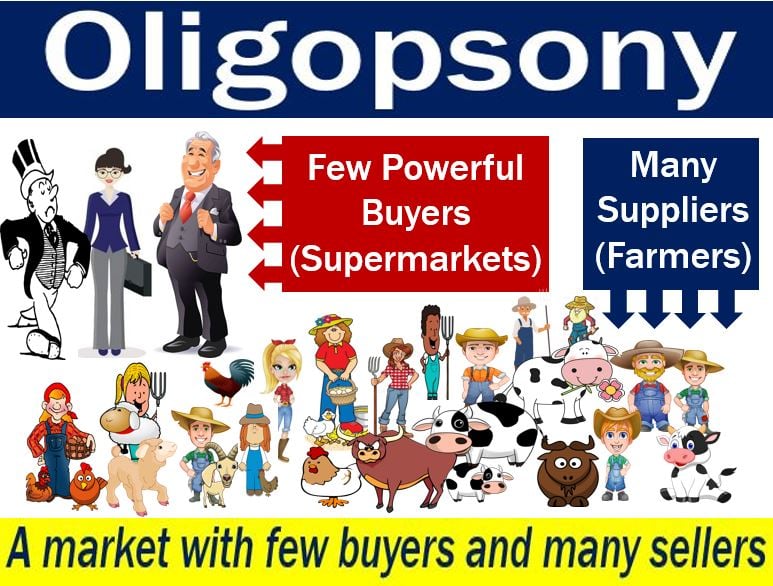
While oligopoly focuses on market dominance by a limited number of firms, oligopsony shifts the attention to the buyer’s side of the market. Oligopsony occurs when there are few buyers or clients in the market, giving them significant control over prices and terms of trade. This concentration of buyer power can lead to imbalanced relationships between suppliers and buyers, affecting the livelihoods of producers.
In an oligopsonistic market, buyers can exert pressure on suppliers by dictating prices, imposing stringent requirements, or exploiting their market position. This can result in decreased profitability for suppliers and limited bargaining power. Oligopsonies are commonly observed in agricultural sectors, where farmers and producers face challenges due to limited buyer options and the necessity to sell their produce at lower prices. This phenomenon, often referred to as the Farm Problem, highlights the adverse effects of imbalanced market power on agricultural communities.
III. Price Elasticity and Market Dynamics.
Price elasticity plays a crucial role in understanding the dynamics of markets, including both oligopoly and oligopsony. Price elasticity measures the responsiveness of demand or supply to changes in price. It indicates how sensitive consumers or producers are to price fluctuations and provides insights into market behavior.
In oligopoly, firms must consider price elasticity when determining their pricing strategies. If demand for a product is highly elastic, meaning consumers are highly responsive to price changes, firms may be hesitant to raise prices significantly as it could lead to a significant loss of market share. On the other hand, if demand is inelastic, firms have more pricing power and can raise prices without a substantial decline in demand.
In the context of oligopsony, price elasticity affects producers’ ability to negotiate fair prices for their products. If supply is highly elastic, meaning producers can easily switch to alternative buyers or products, buyers may face pressure to offer competitive prices to retain suppliers. However, if supply is inelastic, producers have limited alternatives, giving buyers more control over prices.
IV. Implications for the Farm Problem.
The Farm Problem represents a stark illustration of the challenges faced by farmers operating within oligopsonistic market structures. The concentration of buyer power in the agricultural sector puts farmers at a disadvantage, as they often lack the ability to negotiate fair prices for their products. This imbalance in power dynamics can lead to economic instability, reduced profitability, and limited opportunities for growth.
To address the Farm Problem and promote a more equitable agricultural sector, policy solutions must be implemented. These may include fostering competition among buyers, promoting cooperative farming models, providing financial support to farmers, and implementing fair trade practices. By enhancing market transparency, encouraging collaboration among farmers, and implementing supportive policies, governments can play a pivotal role in improving the economic conditions for farmers and ensuring a sustainable agricultural sector.
V. Other Market Dynamics in the Field of Economics
Besides monopoly, oligopsony, and oligopoly, there are other market dynamics that exist in the field of economics. These dynamics represent different degrees of competition and market structure. Some of the other market dynamics include:
- Perfect Competition: Perfect competition is a market structure characterized by a large number of buyers and sellers, homogeneous products, perfect information, free entry and exit, and no individual firm having the power to influence prices. In perfect competition, firms are price takers and face a horizontal demand curve.
- Monopolistic Competition: Monopolistic competition is a market structure characterized by a large number of firms selling differentiated products. Each firm has a certain degree of market power, but there is still a relatively high level of competition. Firms engage in product differentiation to attract customers, and they have some control over prices.
- Monopsony: Monopsony occurs when there is only one buyer or client in a market. This gives the buyer significant control over prices and terms of trade. Monopsony is the buyer-side equivalent of a monopoly and can lead to imbalanced power dynamics between suppliers and buyers.
- Bilateral Monopoly: Bilateral monopoly refers to a market structure in which there is a single buyer and a single seller. Both parties have significant bargaining power and can influence prices and terms of trade through negotiation.
- Duopoly: Duopoly occurs when there are only two firms operating in a market. These firms may compete or collude with each other, depending on their strategic decisions. Duopolistic markets can exhibit a wide range of behaviors, from intense competition to cooperation.
- Monopolistic Oligopoly: Monopolistic oligopoly is a market structure characterized by a small number of firms, each with some degree of market power. These firms may sell differentiated products and engage in strategic behavior, such as advertising or product differentiation, to gain a competitive advantage.
It is important to note that these market dynamics exist on a spectrum, with perfect competition representing the most competitive end and monopoly representing the least competitive end. Each market structure has its own implications for pricing, competition, and overall market outcomes.
VI. Conclusion and Summary.
In conclusion, understanding oligopoly and oligopsony is crucial to comprehend the challenges faced by market participants, particularly in the agricultural sector. Oligopoly involves a few dominant firms exerting influence over pricing and competition, while oligopsony focuses on the concentration of buyer power, often leading to imbalanced relationships between suppliers and buyers. Price elasticity influences the pricing strategies of firms and the ability of producers to negotiate fair prices.
The Farm Problem highlights the adverse effects of imbalanced market power in the agricultural sector, necessitating policy solutions to address these challenges. By fostering competition, promoting cooperation, and implementing supportive policies, governments can empower farmers and create a more equitable and sustainable agricultural system.
Some References:
- Bain, J. S. (1956). Barriers to New Competition. Cambridge: Harvard University Press.
- Carlton, D. W., & Perloff, J. M. (2005). Modern Industrial Organization. Boston: Pearson Education.
- Gilbert, R. J., & Bailey, E. E. (2002). Oligopoly and Resale Price Maintenance: Clarifying the Legal Framework. Antitrust Law Journal, 70(2), 403-436.
- Grant, R. M. (2010). Contemporary Strategy Analysis. Hoboken: John Wiley & Sons.
- Hay, D. A., & Morris, D. (2018). Industrial Economics: Markets and Strategies. Hoboken: John Wiley & Sons.
- Motta, M. (2004). Competition Policy: Theory and Practice. Cambridge: Cambridge University Press.
- Tirole, J. (1988). The Theory of Industrial Organization. Cambridge: MIT Press.
 Food4Innovations (EN) - Wouter de Heij M.Sc.
One thought on “Article II – Understanding Oligopoly and Oligopsony: Balancing Market Dynamics. Including Other Market Dynamics in the Field of Economics.”