MIDDEN is a new but also virtual political party. MIDDEN is a party that will not physically exist but aims to make an impact and inspire based on ideas from society and, above all, on (rational) content and vision. MIDDEN stands for the progress of the Netherlands. MIDDEN stands for innovation, employment, and prosperity. MIDDEN is somewhat liberal but sometimes also conservative and, above all, always social and fair. MIDDEN is substantive and rational thinking party.
MIDDEN wishes to develop a policy that can be implemented, where costs and benefits always ‘add up.’ After all, we are almost all in the middle of the Netherlands, paying taxes and desiring to build a beautiful and sustainable society.
MIDDEN will also be writing an election program in the coming period, as inspiration for all other political parties in the Netherlands. We will start with Energy, but chapters on Housing, Economy (and Industry), Education and Innovation, and other topics will follow in the next three months. Do you have any questions or suggestions? Put them below or send an email.
Chapter 1 – A Robust and Sustainable Energy System (v0)
- MIDDEN wil dat the electricity system remains robust and affordable for all citizens and businesses throughout the Netherlands. The technical system should not lead to blackouts, and the costs for all citizens must remain affordable, with a realistic limit per household, even for lower and middle-income groups.
- MIDDEN believes that the costs for further greening of the energy system should be distributed fairly and evenly among the government, businesses, and citizens, and not disproportionately burden citizens. The government in The Hague should take more control over the design and development of the energy system (currently too decentralized among provinces and municipalities), and regulations related to nitrogen or other legislation should not hinder construction.
- MIDDEN is of the opinion that it is essential for the Netherlands to become much less dependent on oil products, coal, and natural gas in the long term. Climate change is not the primary argument for this, but rather the unpredictable geopolitical situation, which MIDDEN considers an important reason. However, MIDDEN does not want the Netherlands to automatically and completely “get off gas” because the complexity of the system is too great to make such simplistic statements. MIDDEN wants to investigate as soon as possible whether it is wise to enter into long-term gas contracts with friendly nations for stability.
- MIDDEN is not in favor of widespread use of hydrogen in households and residential areas. However, heavy industries are free to use hydrogen as a replacement for fossil fuels as long as it is safe for the immediate environment.
- MIDDEN will continue to support households that want to insulate their homes, voluntarily install heat pumps, and/or place solar panels on their homes. MIDDEN also wants to investigate the role of energy storage systems at home (or in the neighborhood) for the overall system’s robustness and explore the future costs for households. MIDDLE aims for households to be able to live in sustainable homes with acceptable energy costs in the future and, if possible, become less dependent on major energy companies.
- MIDDEN is against reopening gas fields in Groningen. However, if gas from Groningen needs to be pumped in case of emergency, a substantial portion of the income will be given as compensation to that province, which also experiences (potential) damage or inconvenience.
- Importing gas from friendly nations or extracting gas from fields in the North Sea will still be possible, and the current gas buffers will be considered strategic infrastructure and reserves (summer-winter). MIDDEN also wants to ensure sufficient maintenance of the entire existing gas network to make it future-proof. Expanding the gas network is not ruled out.
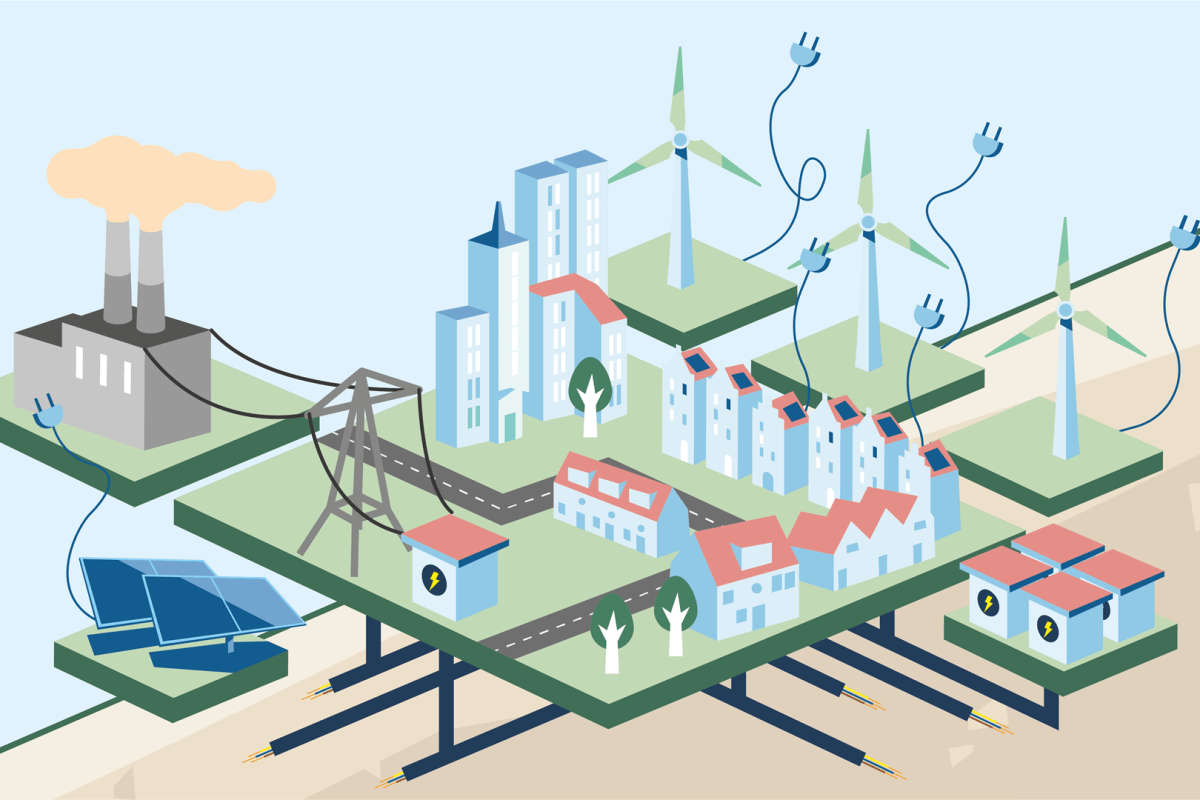
- MIDDEN wants accelerated investment in the electricity network in the Netherlands. The network should not hinder the expansion of sustainable electricity supply and should not obstruct further electrification of industries and households. Therefore, the network should be developed to a state of overcapacity. Network companies will also be motivated to actively create electricity storage capacity. Acceleration of the rollout of PV and wind production capacity can only occur if the network infrastructure is in order.
- MIDDEN is opposed to the use of biofuels grown on agricultural areas (first generation). MIDDEN is cautious about using wood from production forests and opposes the use of wood from natural forests as fuel for power plants. Residues from the agro-food sector can potentially be used as co-digestion materials. MIDDEN is not fundamentally opposed to second-generation biofuels but expects little added value.
- MIDDEN believes that a state-owned company should be established immediately with the goal of operating one or more nuclear power plants within ten years. These state-owned plants will be distributed across the Netherlands. These nuclear plants and modern gas-fired power plants should continue to exist as backup and base supply to compensate for the fluctuating production of PV and wind. Possible locations for nuclear power plants are a) Borsele, b) near Lelystad, c) near Geleen, with the condition of sufficient cooling water available in the long term. It is currently not logical to install micro nuclear power plants scattered throughout the Netherlands.
- MIDDEN believes that we should be more cautious about designating new wind farms on land. Old (depreciated) wind turbines on land should be replaced first. MIDDEN also believes that (agricultural) land should not be used for the construction of new solar parks. However, all rooftops of houses, offices, and other buildings and parking lots should be designated for the installation of additional PV capacity.
- MIDDLE believes that companies should be obligated to invest in PV on their roofs when constructing new buildings. MIDDEN supports further investments in large offshore wind farms, but a critical examination of government subsidies for these offshore wind farms is necessary.
- MIDDEN believes that, like farmers, the (manufacturing and heavy) industries in the Netherlands should be allowed to continue to exist (perhaps as a form of industrial policy). These industries should, however, accelerate their transition to cleaner processes, with a clear focus on reducing emissions to air, soil, and water. Hydrogen and electricity can play a role in these projects, provided that the industry takes the lead. MIDDEN is willing to support with knowledge and resources.
- MIDDEN is not against CCS (carbon capture and storage) and supports the implementation of the first large-scale projects offshore or near the coast.
 Food4Innovations (EN) - Wouter de Heij M.Sc.