
The concept of deposition velocity plays a crucial role in modeling how pollutants transfer from the atmosphere to the surface. This process is controlled by three main resistances: aerodynamic resistance (Ra), boundary layer resistance (Rb), and surface resistance (Rc). Each of these resistances serves a unique purpose and depends on various environmental and physical factors.
The first, aerodynamic resistance (Ra), represents the resistance that air exerts on pollutants moving downwards through the atmosphere. This resistance is influenced by the wind speed and the roughness of the surface, meaning that higher wind speeds and rougher surfaces (such as in urban or forested areas) reduce RaRa, thereby enhancing pollutant transport to the surface. Aerodynamic resistance thus forms the primary pathway for pollutants in the atmosphere, pushing them toward the ground.
Boundary layer resistance (Rb), the second resistance, occurs within a thin layer of air just above the surface. Here, air movement becomes more organized, flowing in layers rather than turbulently. The thickness and resistance of this layer depend on the pollutant properties, as well as environmental conditions like temperature and turbulence. The boundary layer acts as a transitional zone, where deposition slows slightly before pollutants reach the ground.
The final resistance, surface (or canopy) resistance (Rc), depends on how easily the surface itself absorbs the pollutant. For gases like ammonia, specific factors, including surface moisture and the acidity of the land or water, play a large role in this resistance. Surface resistance varies with land type and vegetation; a forest, for example, might absorb pollutants differently than a grassland or water surface. Unlike the previous resistances, which primarily relate to atmospheric conditions, RcRc reflects biological and chemical properties of the surface, influenced by factors such as the leaf area index (LAI), surface moisture, and the respiration rate of plants.
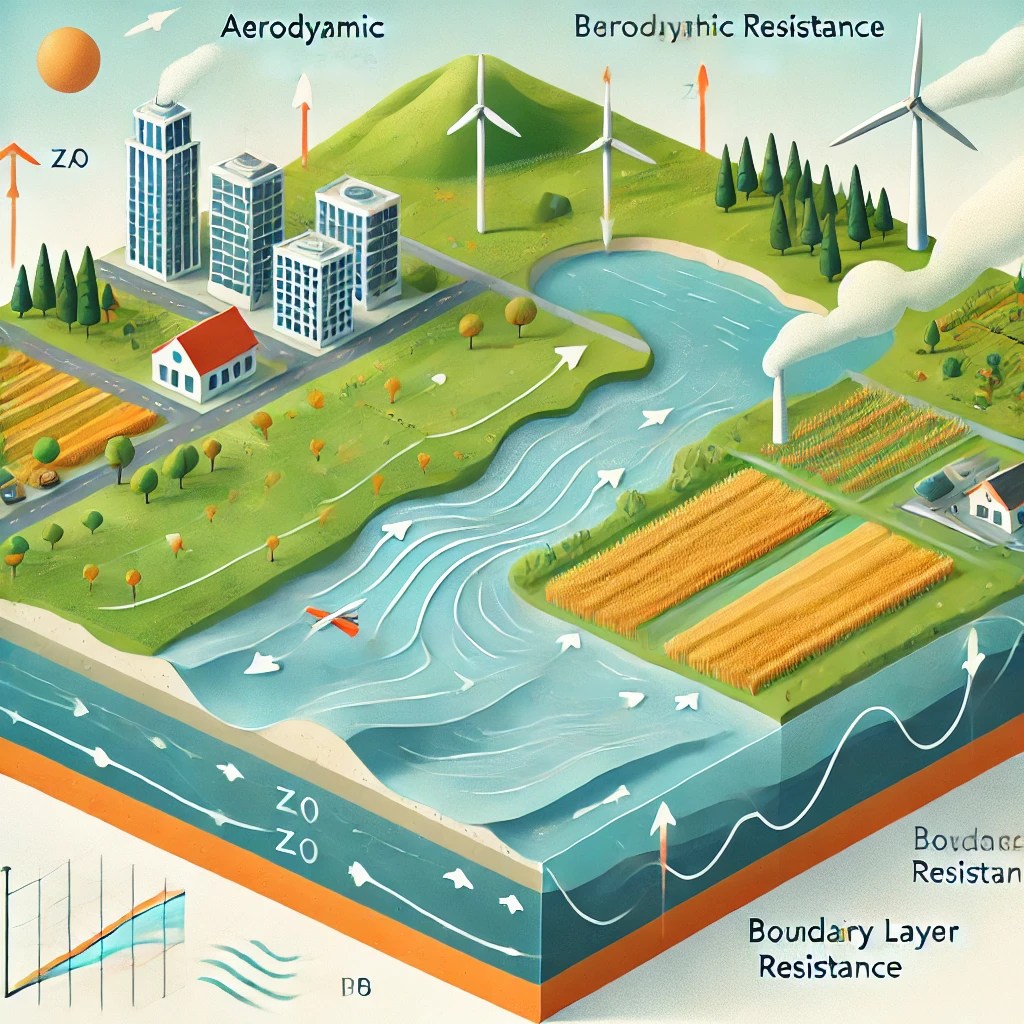
Mathematically calculating the values of Ra and Rb requires several key parameters, with roughness length (z0) and displacement height (d) being particularly important. Roughness length reflects the impact of small-scale surface elements (like crops, grass, or buildings) on air movement, and it varies significantly depending on the land type.
In the Netherlands, for example, agricultural areas generally have a roughness length around 0.1 m, while urban areas measure closer to 1.0 m, and water surfaces show a minimal roughness length near 0.0001 m. Displacement height, on the other hand, represents an effective height above the ground where the average airflow is impacted by obstacles, such as trees or buildings, and is usually set at approximately two-thirds of the height of these roughness elements.

The influence of roughness length and displacement height on aerodynamic and boundary layer resistance can be visualized effectively in a graph, as shown below, which reflects typical values for different land types in the Netherlands.
Although the physics behind aerodynamic and boundary layer resistances is well understood, enabling us to calculate these resistances with relative ease, surface resistance (Rc) remains a complex variable. Its dependency on vegetation type and environmental conditions means it requires further experimental investigation, especially across various types of vegetation and land use. Improved understanding of Rc could significantly enhance the accuracy of deposition models, which are essential for environmental policy and air quality management.

Also about this subject, the following articles:
- Understanding Dry Deposition: Mechanisms, Modeling Challenges, and the Complexities of Ammonia’s Interaction with Different Surfaces in Environmental Systems
- “The Oversights in the Nitrogen Dossier Listed” – an explanation of the uncertainties and qualitative interpretation where nitrogen science still has some weaknesses. (See also the publication and discussion on Foodlog, December 12, 2023)
- The Spacial Planning challenge of the Netherlands. My country becomes a bit too ‘busy’. To do everything always, at every place is not possible and thus I say: “Den Haag (Houston) we have a problem (no, a challenge)!”
 Food4Innovations (EN) - Wouter de Heij M.Sc.