
From Dream to Reality: The Struggles, Passion, and Disappointments of a Physicist (Sabine Hossenfelder) in the Academic System

Sabine Hossenfelder, a renowned physicist and science communicator, shares a deeply personal and insightful story in her YouTube video, “My Dream is Dead, and Now I’m Here.” Her account offers a raw perspective on the challenges of academia, the quest for authenticity, and the decision to carve a new path.

A Young Scientist’s Dream

Sabine began her studies in physics with grand expectations, inspired by stories of past scientists: intellectual debates, groundbreaking discoveries, and the feeling of contributing to something greater. However, as she recounts, this vision was naïve. The academic world was far less focused on curiosity and collaboration than she had hoped.

The Harsh Reality

Early in her career, Sabine encountered systemic barriers. As a woman, she faced discrimination when told to apply for a women-only scholarship so that the university wouldn’t have to pay her salary. While she secured the scholarship, it came with other challenges, such as a lack of benefits and constant reminders that she “didn’t really belong” at the institute.

Her experiences reveal broader shortcomings in academia. Researchers are often forced to focus on “safe” and financially appealing topics rather than truly innovative ones. The pressure to secure research grants and produce publications fosters a culture where young scientists are burned out in a paper-production machine.

A Dream Transformed

Sabine’s story is also a reflection on her personal struggles with the system. She admits to conducting research that had little impact, simply because it brought in funding. This took a toll on her mental health and personal life. Years later, when she transitioned to YouTube, she discovered a new way to share science and rediscover meaning in her work.

The Shift to YouTube

Sabine’s decision to become a science communicator on YouTube wasn’t easy but ultimately liberating. She left behind a world of temporary contracts and grant proposals for a platform where she could directly connect with an audience that shares her passion. She calls it “an honest trade”: her knowledge in exchange for her viewers’ attention.

With a team spread across the globe and a community interested in topics like quantum physics, Sabine has found a way to make science accessible and relevant again.

A Critical View of Academic Science

In her video, Sabine critiques the academic culture that prioritizes quantity over quality. She warns that a system reliant on publications and funding can become more bureaucratic than scientific. However, she emphasizes that her experience is not universal; many academics thrive within this system.

An Inspirational Journey

Sabine’s transition from scientist to independent communicator demonstrates how dreams can evolve and still remain meaningful. Her story invites us to think critically about how we support and value science.

For anyone who has ever doubted their career or aspirations, Sabine’s journey is a powerful reminder that reinvention is possible without losing your passion.

Conclusion: A New Path in Science

Sabine Hossenfelder proves that it’s possible to stay true to your ideals, even if it means taking a different road. Her story reminds us that science isn’t confined to labs but also lies in how we share and understand knowledge.

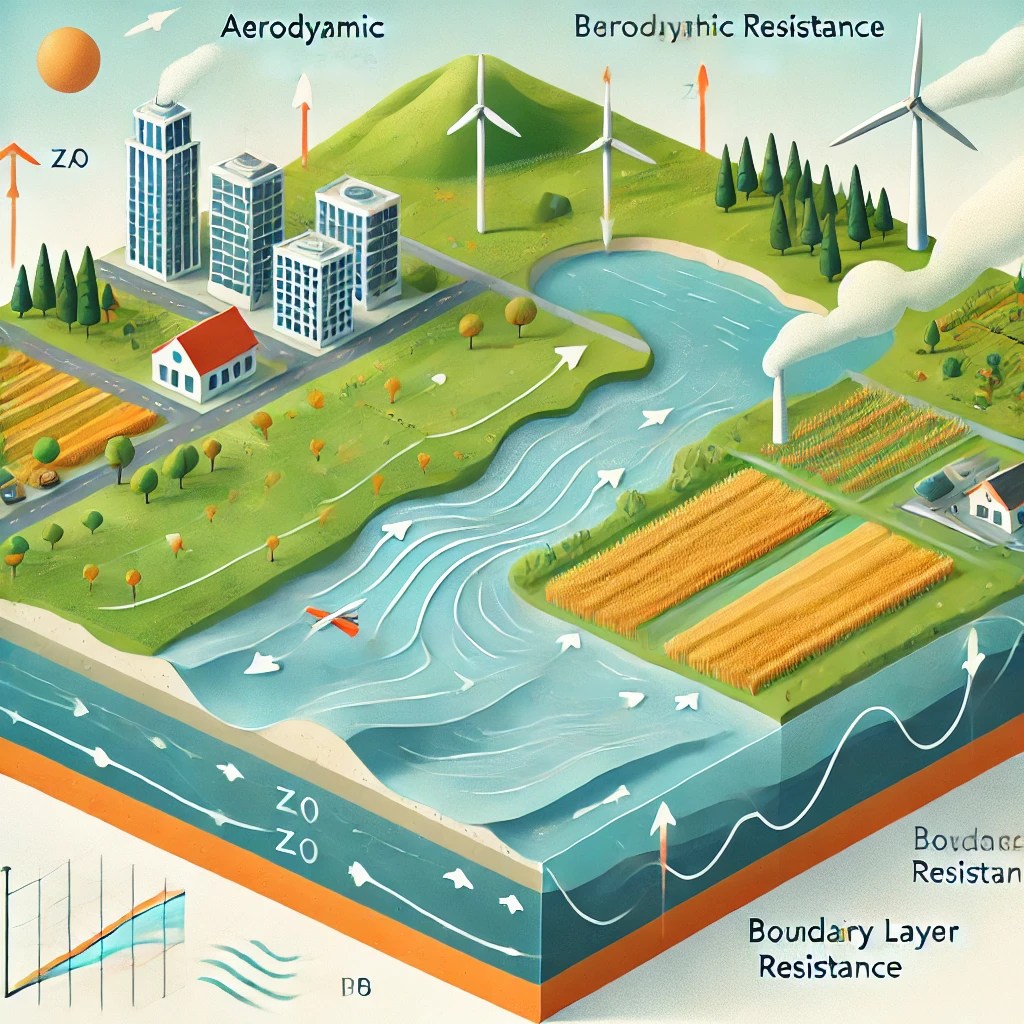
The Role of Surface Roughness in Shaping Aerodynamic and Boundary Layer Resistance: Insights into Deposition Velocities and Environmental Modelling

The concept of deposition velocity plays a crucial role in modeling how pollutants transfer from the atmosphere to the surface. This process is controlled by three main resistances: aerodynamic resistance (Ra), boundary layer resistance (Rb), and surface resistance (Rc). Each of these resistances serves a unique purpose and depends on various environmental and physical factors.

The first, aerodynamic resistance (Ra), represents the resistance that air exerts on pollutants moving downwards through the atmosphere. This resistance is influenced by the wind speed and the roughness of the surface, meaning that higher wind speeds and rougher surfaces (such as in urban or forested areas) reduce RaRa, thereby enhancing pollutant transport to the surface. Aerodynamic resistance thus forms the primary pathway for pollutants in the atmosphere, pushing them toward the ground.

Boundary layer resistance (Rb), the second resistance, occurs within a thin layer of air just above the surface. Here, air movement becomes more organized, flowing in layers rather than turbulently. The thickness and resistance of this layer depend on the pollutant properties, as well as environmental conditions like temperature and turbulence. The boundary layer acts as a transitional zone, where deposition slows slightly before pollutants reach the ground.

The final resistance, surface (or canopy) resistance (Rc), depends on how easily the surface itself absorbs the pollutant. For gases like ammonia, specific factors, including surface moisture and the acidity of the land or water, play a large role in this resistance. Surface resistance varies with land type and vegetation; a forest, for example, might absorb pollutants differently than a grassland or water surface. Unlike the previous resistances, which primarily relate to atmospheric conditions, RcRc reflects biological and chemical properties of the surface, influenced by factors such as the leaf area index (LAI), surface moisture, and the respiration rate of plants.

Mathematically calculating the values of Ra and Rb requires several key parameters, with roughness length (z0) and displacement height (d) being particularly important. Roughness length reflects the impact of small-scale surface elements (like crops, grass, or buildings) on air movement, and it varies significantly depending on the land type.

In the Netherlands, for example, agricultural areas generally have a roughness length around 0.1 m, while urban areas measure closer to 1.0 m, and water surfaces show a minimal roughness length near 0.0001 m. Displacement height, on the other hand, represents an effective height above the ground where the average airflow is impacted by obstacles, such as trees or buildings, and is usually set at approximately two-thirds of the height of these roughness elements.

The influence of roughness length and displacement height on aerodynamic and boundary layer resistance can be visualized effectively in a graph, as shown below, which reflects typical values for different land types in the Netherlands.

Although the physics behind aerodynamic and boundary layer resistances is well understood, enabling us to calculate these resistances with relative ease, surface resistance (Rc) remains a complex variable. Its dependency on vegetation type and environmental conditions means it requires further experimental investigation, especially across various types of vegetation and land use. Improved understanding of Rc could significantly enhance the accuracy of deposition models, which are essential for environmental policy and air quality management.

Also about this subject, the following articles: